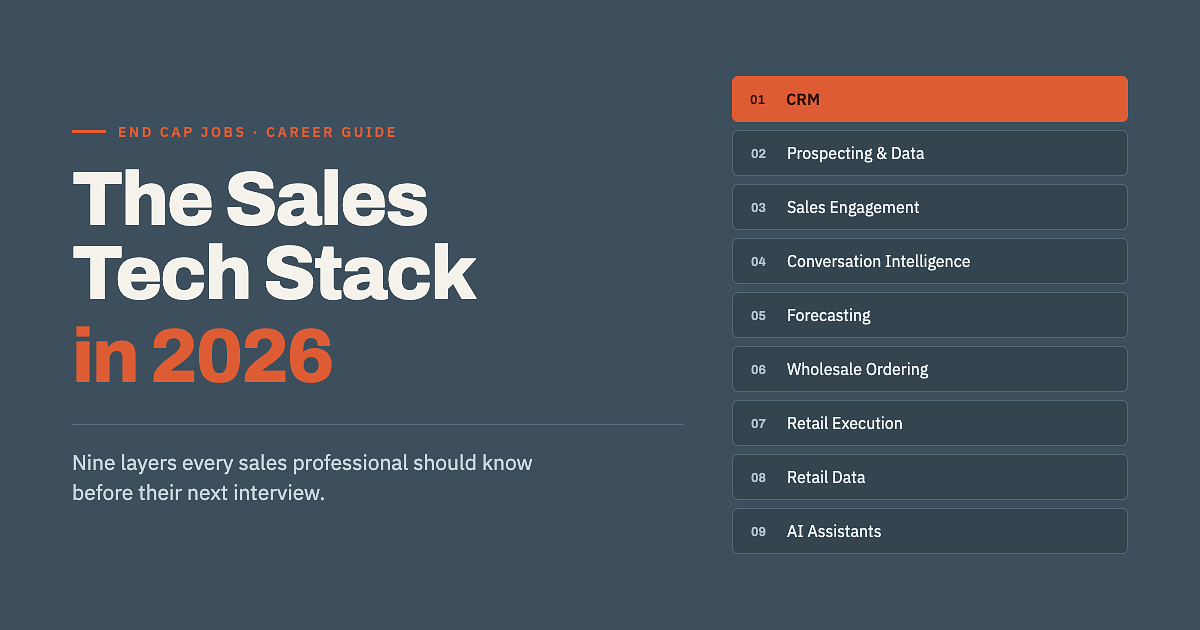
The Sales Tech Stack in 2026: Tools Every Sales Professional Should Know Before Their Next Interview
There's a question showing up in sales interviews that didn't used to be there.
It's not "walk me through your quota attainment." It's some version of: "What does your stack look like?" Or more pointedly: "Our reps run Salesforce, Apollo, and Gong. How much of that have you actually used?"
Hiring managers ask because ramp time is expensive. A rep who has to learn the product, the territory, and four unfamiliar platforms takes two quarters longer to contribute than one who only has to learn the first two. Tool fluency has quietly become a hiring filter — not because the tools are hard, but because knowing them is now assumed.
This guide maps the stack layer by layer. For each one: what it does, the names worth knowing, the question you'll get asked, and how to get hands-on before you're sitting in front of a VP of Sales.
A note before we start: nobody uses all of this. Your stack depends on whether you sell software, sell physical product into retail, or manage a dealer network. We've covered both the B2B tech stack and the wholesale/retail stack, because most of our readers live in the second one and most "sales tools" articles pretend it doesn't exist.
Layer 1: CRM — The System of Record
This is the non-negotiable one. Every sales job has a CRM, and how you treat it says more about you as a candidate than almost anything else on your resume.
Names to know: Salesforce Sales Cloud remains the enterprise benchmark, holding roughly a quarter of the global CRM market by revenue. HubSpot dominates mid-market and has the most generous free tier. Microsoft Dynamics 365 shows up in Microsoft-heavy organizations. Pipedrive is the common choice for small, pipeline-focused teams. A newer generation — Attio, Close, Folk — is built around automatic data capture rather than manual entry.
What changed in 2026: AI in the CRM moved from suggesting to acting. Salesforce's Agentforce, HubSpot's Breeze agents, and Microsoft's Copilot now qualify leads, draft follow-ups, and update records without a human starting the task. Notably, most vendors have decoupled AI pricing from the per-seat price, so the number on the pricing page is a floor rather than a total. You don't need to know the pricing, but you should know the shift — it's why "CRM admin work" is a shrinking excuse for a thin pipeline.
The interview question: "How do you keep your pipeline accurate?"
The bad answer describes logging activity. The good answer describes stage exit criteria — what has to be true for a deal to move from stage three to stage four — and how you audited your own data. Talk about deal aging, slipped deals, and how close your forecast landed to actual.
How to get hands-on: HubSpot's free CRM tier is genuinely functional. Salesforce offers free Developer Edition orgs, and Trailhead is free, self-paced, and produces badges you can put on LinkedIn. A weekend in Trailhead is the single highest-return thing an underemployed rep can do.
Layer 2: Prospecting and Sales Intelligence
Where your target list comes from, and whether the contact data in it is real.
Names to know: ZoomInfo has the deepest enterprise database and the strongest direct-dial coverage. Apollo.io is the price-to-value leader for SMB and mid-market, bundling data with sequencing. Clay works differently — instead of owning one database, it pulls from 100-plus providers using what the category calls waterfall enrichment, and lets you build custom research workflows. Cognism leads on GDPR-compliant EU and UK phone data. LinkedIn Sales Navigator remains the social prospecting standard. Hunter and Lusha cover quick, cheap lookups.
What changed in 2026: Two things. First, data decay got taken seriously — B2B contact data degrades somewhere in the range of 22 to 30% annually, meaning a list that's 95% accurate today is meaningfully worse in a year without active verification. Second, email deliverability tightened sharply as the major inbox providers cracked down on unauthenticated bulk mail. The practical effect: volume-based outbound works worse than it did two years ago, and signal-based outreach — triggered by a hire, a funding round, a new store opening, a category reset — works better.
The interview question: "How do you build a target list?"
Answer with a method, not a tool name. Define the ideal customer profile, identify the trigger you're watching for, describe how you verify contact data, and say what your reply rate was.
How to get hands-on: Apollo, Clay, ZoomInfo Lite, Hunter, and Lusha all have free tiers. Build a real target list of 50 accounts in your industry this week. You'll learn the tool and produce something you can reference in an interview.
Layer 3: Sales Engagement and Sequencing
The layer that runs multichannel outreach at scale — email sequences, call tasks, LinkedIn touches.
Names to know: Outreach and Salesloft are the enterprise standards. HubSpot Sales Hub covers it for teams already on HubSpot. Instantly and Smartlead serve high-volume cold outbound.
The interview question: "Walk me through a sequence you built."
Know your numbers: how many touches, over how many days, across which channels, and what your open and reply rates were. Then explain one thing you changed and what it did to the result. That last part is what separates a rep who ran sequences from a rep who improved them.
A word of caution: the fully autonomous "AI SDR" category had a rough 2025 and 2026, with several heavily funded vendors facing significant churn and credibility problems. If an interviewer brings it up, healthy skepticism is the right posture — AI is excellent at research, drafting, and prioritization, and still unreliable at owning a relationship unsupervised.
Layer 4: Conversation Intelligence
Call recording, transcription, and analysis. Gong and Chorus lead the category; Fathom, Fireflies, and Otter are the lightweight options.
These tools record the call, transcribe it, surface talk ratios and objection patterns, and push structured notes back into the CRM. For a hiring manager, they replace impression-based coaching with actual data.
The interview question: "How do you take coaching?"
This is really a question about whether you'll resist being recorded. The strong answer: you welcome it, you've reviewed your own calls, and here's something you changed because of what you heard. Reps who lean into conversation intelligence ramp faster, and interviewers know it.
How to get hands-on: Fathom and Fireflies have free tiers. Record and review your own mock calls.
Layer 5: Forecasting and Revenue Intelligence
Clari is the category leader, and forecasting capability is increasingly bundled into engagement platforms as the market consolidates.
Most individual contributors never touch these tools directly, but the vocabulary matters — especially if you're interviewing for a manager or director role. Know pipeline coverage ratio, deal velocity, win rate by stage, and the difference between leading indicators (meetings booked, pipeline created) and lagging ones (quota attainment, closed revenue).
The interview question: "What coverage ratio did your team run?"
If you don't know, say so and say what you tracked instead. Guessing at a number you don't understand is worse than admitting the gap.
Layer 6: Wholesale Ordering and Rep Platforms
Now we get to the layer most sales-tech articles skip entirely — and the one that matters most if you sell physical product into retail.
Names to know: Elastic Suite is built around seasonal pre-book cycles and is widely used in outdoor and sporting goods. RepSpark serves rep-driven categories including golf, specialty, and tactical. NuORDER (now part of Lightspeed) has deep department store and boutique reach. JOOR is the fashion standard. Brandboom is the lean starting point for smaller brands. Faire is where independent retailers discover emerging brands.
For independent rep groups, the dominant tools are MarketTime, Brandwise, and RepZio — all now under common ownership — with challengers like WizCommerce pushing AI-first order capture. If you're interviewing with a rep agency or a brand that sells through one, knowing these names is the difference between sounding like an insider and sounding like a tourist.
The interview question: "How do you run a pre-book season?"
Line sheets, digital catalogs, order deadlines, ATS (available to sell) visibility, and how you handle a buyer who wants to cut their order in week three. Specific platform experience is a plus, but the workflow knowledge is what they're testing.
How to get hands-on: These are closed platforms without free tiers, so this is a read-and-research layer. Most vendors publish detailed product pages and demo videos. Watch two, and know which platform your target employer uses before you walk in — it's usually discoverable from their dealer portal or a job posting.
Layer 7: Retail Execution and Field Sales
If the role involves store visits, this is your daily software.
Names to know: Repsly is the merchandiser-first standard for CPG field teams — route planning, visit scheduling, digital checklists, photo capture, and rep dashboards. GoSpotCheck by FORM is strong on audit-heavy programs. Pepperi and SimplyDepo bundle order capture with execution for distributors and DSD routes.
What changed: image recognition. Instead of a rep counting facings by hand, the platform reads the shelf photo and compares it against the planogram automatically. Vendors report detection accuracy moving from roughly 60–70% with manual observation to 90–95% with computer vision, and the gap gets flagged while the rep is still in the store rather than in a report three weeks later.
The interview question: "What does a good store visit look like?"
Planogram compliance, on-shelf availability, pricing accuracy, competitive positioning, promotional execution, and the relationship with the store manager. Then: what you documented, and what you did with it.
Layer 8: Retail Data and Account Intelligence
For national account managers, this is where line reviews are won or lost.
Names to know: NielsenIQ and Circana are the syndicated data platforms — category volume, brand share, competitive tracking, price and promotion benchmarking. Retailer-specific portals matter just as much: Walmart's Retail Link and Luminate, Amazon Vendor and Seller Central, Target's Partners Online, and equivalents at most major chains. SPS Commerce and similar EDI providers handle the transaction layer. RangeMe is where buyers discover new products.
The hard truth to know going in: the buyer sitting across from you often has fresher data than you do. Syndicated reports run weeks behind. That's why the sharpest account managers pair syndicated data with their own field-verified store-level data.
The interview question: "How do you prepare for a line review?"
Category growth, your share trend, sell-through velocity by SKU, distribution gaps, the competitive set, and a clear recommendation on what to cut and what to add. Bring a point of view, not a data dump.
Layer 9: General-Purpose AI Assistants
ChatGPT, Claude, and Perplexity are now part of the everyday sales workflow, and several CRM and prospecting platforms have shipped integrations that let reps query their own data through a chat interface.
The high-value uses for a working rep: pre-call research and account briefs, summarizing a 40-page category report before a buyer meeting, drafting and pressure-testing a proposal, building a territory plan, and role-playing objections.
The interview question: "How are you using AI in your work?"
Answer with one concrete workflow and one result. "I use AI to write emails" is a weak answer. "I built a pre-call brief prompt that pulls together the account's order history, recent news, and open items, and it cut my prep from 30 minutes to five" is a strong one.
How to Talk About Tools Without Overclaiming
Three rules.
Rule one: depth beats breadth. Two tools you can discuss in detail will beat ten you can only name. Interviewers probe, and a thin claim collapses fast.
Rule two: lead with the workflow, not the logo. Tools change; the thinking transfers. A rep who can explain why they segmented a territory a certain way will learn any platform in a month.
Rule three: be honest about gaps, then show the plan. "I haven't used Gong, but I've reviewed my own recorded calls in Fathom and I'd expect the transition to take a week" is a good answer. Pretending otherwise gets found out in the first month.
Frequently Asked Questions
What sales tools should I learn first if I'm between jobs? Salesforce Trailhead and HubSpot Academy, in that order. Both are free, both issue credentials, and both cover systems that appear in the majority of sales job postings.
Do I need to know every tool listed in a job description? No. Postings are wish lists. Know the CRM named, have a working understanding of the category for the rest, and be direct about what you haven't used.
What tools matter most for outdoor and sporting goods sales roles? The wholesale ordering platform your target brand runs (commonly Elastic Suite, RepSpark, NuORDER, or Brandboom), the rep-group system if you're working through agencies, and a CRM. Add retail execution software if the role includes store visits.
Is AI replacing sales reps? Not in relationship-driven or field sales. It is compressing the administrative half of the job, which raises the bar on the half that's left — judgment, negotiation, and account relationships.
How do I prove tool experience without a current job? Build something. A 50-account target list in Apollo or Clay, a mock pipeline in HubSpot, a territory plan you can show. Artifacts beat assertions.
The Takeaway
The stack isn't the job. Nobody gets promoted for CRM hygiene, and no buyer ever placed an order because a rep had a clean dashboard.
But in 2026, tool fluency is the price of admission. It's what tells a hiring manager you'll be productive in month two instead of month six — and it frees you up to spend your energy on the part of the job that has always decided who wins: knowing the category, knowing the buyer, and being the rep they call back.
Looking for your next sales role? Browse open positions on End Cap Jobs — territory managers, national account managers, regional sales managers, and sales leadership roles from brands and retailers actively hiring.
Hiring a rep who already knows the category? Post a job on End Cap Jobs.